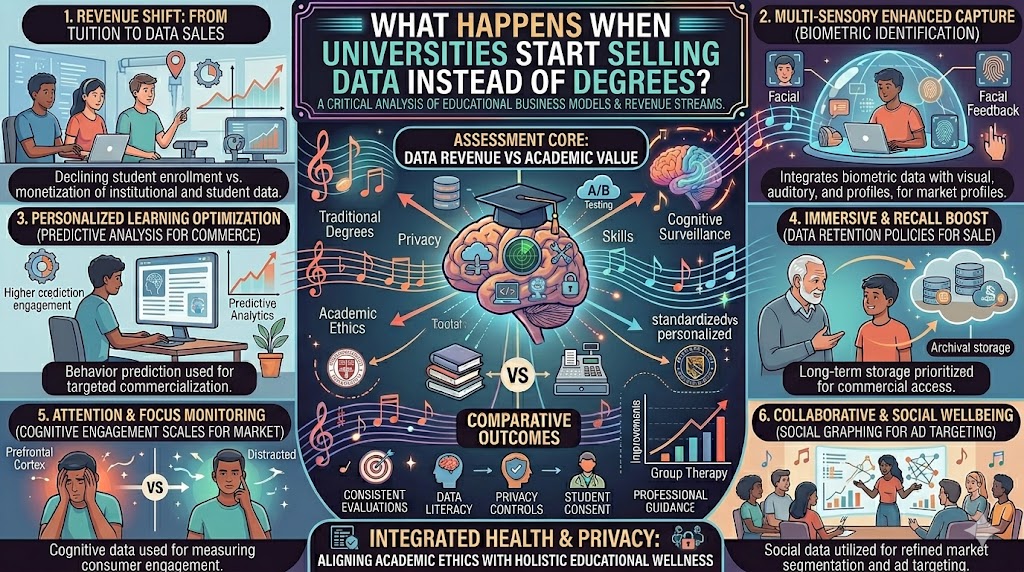
What Happens When Universities Start Selling Data Instead of Degrees?
Universities are turning student data into a valuable asset, shifting from education providers to data-driven ecosystems, raising serious concerns about privacy, ethics, and corporate control.


🧠 Introduction: The Silent Shift in Higher Education
Universities have always been seen as institutions that sell one thing—education. Degrees, knowledge, research opportunities, and career pathways have defined their value for centuries. But in the digital era, a new invisible currency is emerging: student data.
Every click on a learning portal, every attendance scan, every library login, every assignment submission, and even every campus movement is now data. And increasingly, universities are discovering that this data can be more valuable than tuition fees.
What happens when universities stop thinking of students as learners—and start seeing them as data-generating assets?
The answer reshapes education, privacy, ethics, and even democracy.
📊 The Rise of the “Data Economy” in Universities


Universities today operate like digital ecosystems. Learning management systems, campus apps, AI grading tools, and cloud-based classrooms all generate massive datasets.
This shift is part of what researchers call the data economy in higher education, where institutions collect, analyze, and sometimes monetize student information for:
- Predicting academic performance
- Tracking attendance and behavior
- Improving institutional rankings
- Partnering with tech companies
- Developing AI training datasets
According to research on educational data mining, universities increasingly use “learning analytics” to analyze everything from student engagement to mental health patterns (SSRN).
But the critical shift is this: data is no longer just used internally—it is becoming a commercial asset.
💰 How Universities Actually Sell Student Data


Contrary to popular belief, universities rarely “sell data” directly in simple transactions. Instead, monetization happens in subtle ways:
1. Data Partnerships with Tech Companies
Universities collaborate with EdTech and AI firms to improve systems. In exchange, companies gain access to anonymized or semi-anonymized student data.
2. Learning Analytics Platforms
External vendors process student data to create performance predictions, retention models, and behavioral insights.
3. Recruitment and Marketing Data Sharing
Some institutions license student information to third parties for marketing purposes—similar to how standardized testing organizations share student profiles (Axios).
4. Research Commercialization
Student behavior data is used in research projects that are later commercialized as AI tools or educational products.
5. Data Brokers
In more controversial cases, data flows into broader data broker ecosystems, where it is combined with other datasets and resold for targeting.
Even when anonymized, data can often be re-identified, especially when combined with other digital footprints.
🔍 The Hidden Cost: Loss of Student Privacy


One of the biggest concerns in modern universities is the erosion of informational privacy.
Studies show many students are unaware of how deeply their data is collected and used (SSRN). This creates a major ethical imbalance: universities know everything about students, but students know very little about how their data is used.
Key privacy risks include:
- Behavioral tracking without explicit awareness
- Predictive profiling of academic success or failure
- Emotional or mental health inference
- Continuous surveillance via campus systems
- Third-party data sharing without meaningful consent
In some cases, students cannot opt out of data collection entirely, because participation is tied to basic academic participation systems.
This creates what scholars call a “data asymmetry”—a system where institutions have power through information dominance.
⚖️ Ethical Dilemma: Education vs Exploitation


The central question is not whether data should be used—but how far is too far?
Universities argue that data improves:
- Personalized learning
- Dropout prevention
- Academic support systems
- Institutional efficiency
But critics argue the risks outweigh the benefits when:
- Students are not informed properly
- Data is used for profit rather than learning
- AI systems make decisions about student futures
- Third parties gain access without transparency
This creates a tension between innovation and exploitation.
Universities are becoming both educators and data corporations—a dual identity that is difficult to regulate.
🧠 When Students Become “Data Products”


In a data-driven university system, each student becomes a predictive model:
- GPA becomes a performance score
- Attendance becomes engagement probability
- Quiz results become behavioral indicators
- Online activity becomes attention measurement
These data points are used to predict:
- Dropout risk
- Career success likelihood
- Learning speed
- Emotional engagement
While this may sound helpful, it also reduces a human being into a statistical profile.
And once data is monetized, students are no longer just learners—they are products packaged into datasets.
🏢 Corporate Influence: Who Really Controls Education Data?
Tech companies now play a major role in education infrastructure:
- Cloud platforms host university systems
- AI companies analyze student performance
- EdTech firms design learning environments
- Data brokers aggregate information across institutions
A recent trend shows universities partnering with AI companies to deploy autonomous systems that manage student lifecycle operations.
This creates a dependency loop:
- Universities generate data
- Companies process and refine it
- Universities rely on those companies again
Eventually, control shifts from academic institutions to corporate platforms.
🌐 The Global Data Education Ecosystem


The data economy in education is not local—it is global.
Universities across countries are:
- Sharing research datasets
- Using global cloud providers
- Participating in international AI training systems
- Standardizing student analytics frameworks
This raises cross-border concerns:
- Whose laws govern student data?
- Can data travel between countries freely?
- Who owns datasets created in one nation but processed in another?
Education is becoming part of a global surveillance-capable infrastructure, even if unintentionally.
🚨 What Could Go Wrong?
If universities continue prioritizing data monetization over ethics, several risks emerge:
1. Permanent Digital Profiles
Students may carry lifelong “data reputations.”
2. Algorithmic Bias
AI systems may unfairly classify students based on incomplete data.
3. Surveillance Culture
Learning environments may become psychologically restrictive.
4. Data Breaches
Large centralized datasets become high-value cyber targets.
5. Loss of Trust
Students may stop trusting educational institutions entirely.
🔮 The Future: Can Data Be Used Responsibly?
A better future is still possible—but only if universities adopt strict frameworks:
- Transparent data usage policies
- Student consent with real opt-out options
- Ethical AI governance boards
- Strict limits on third-party sharing
- Data minimization principles
- Student ownership of personal academic data
Some institutions are already experimenting with “data fiduciary” models where universities act as guardians rather than owners of student data.
🧾 Conclusion
When universities start selling data instead of degrees, education shifts from a human-centered system to a data-driven marketplace.
The danger is not technology itself—it is the silent transformation of students into datasets without awareness, consent, or control.
If education is the foundation of society, then student data is becoming its hidden currency. And the way we manage it will define the future of learning itself.